
Aliya Zhadyranova
Speciality: Physics. Winner of the Yessenov Data Lab Program.
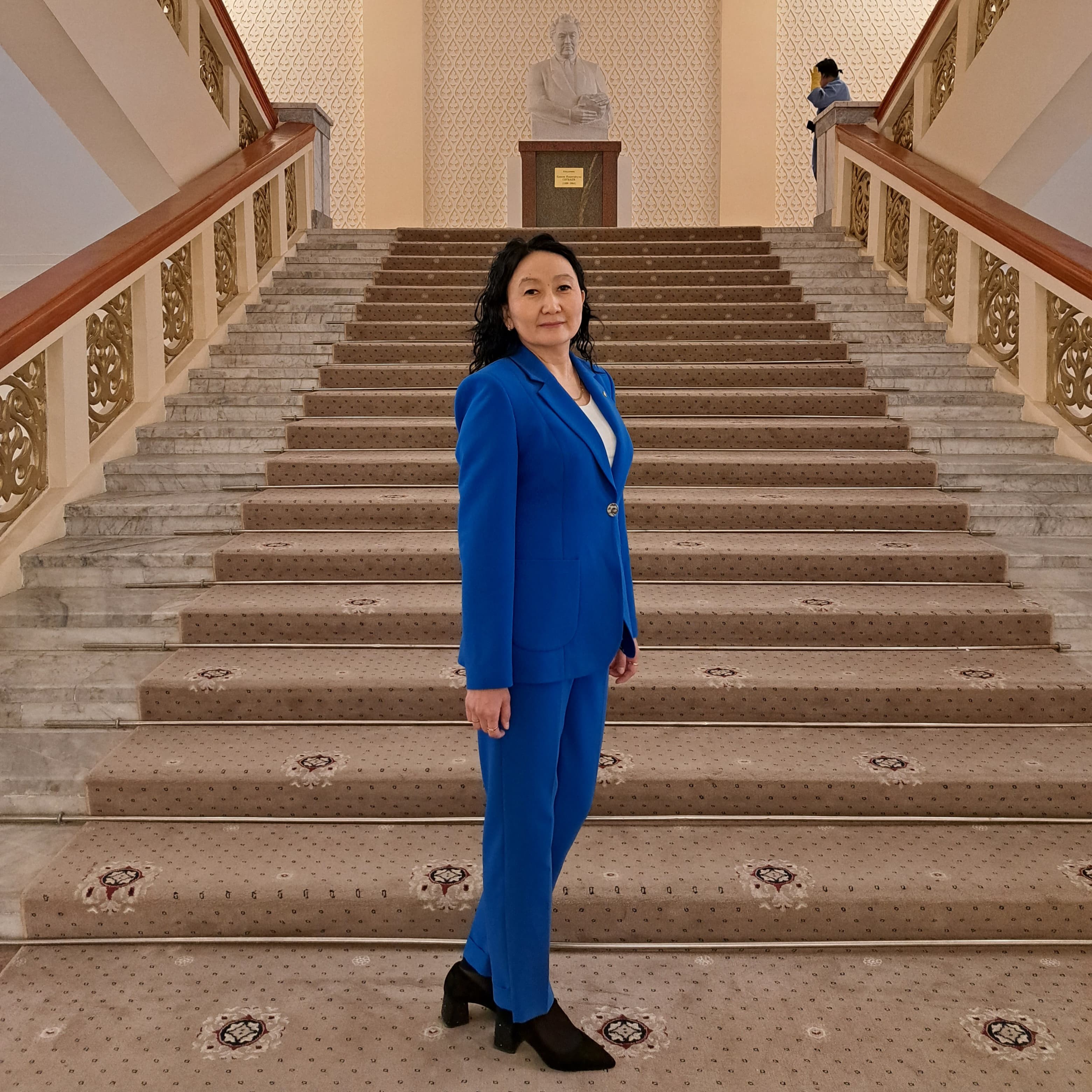 Aliya Zhadyranova, a researcher at the L.N. Gumilyov Eurasian National University (ENU), specializes in cosmology. A serious background in theoretical physics, together with the knowledge she acquired at the Yessenov Data Lab (YDL), supports the scientist in her work. A Doctor of Sciences from Semey, currently working in Astana, shares her experience of studying at the Summer School for Data Analysts. The Shakhmardan Yessenov Foundation, established by Galimzhan Yessenov, has been conducting the YDL annually since 2018. Applications for the Program will be opening soon. Perhaps it is time to change the trajectory of your life as well.
Why Physics?
My school teacher instilled in me the habit of solving problems not by following a template, but by analyzing conditions and laws. After trying this approach on simpler tasks, I gradually became interested in more complex ones. That was when I realized that physics is the language describing how this world is structured and how it functions. That is why I chose physics. It is this science that develops logical thinking and the ability to work with facts, while also encouraging to study mathematics.
Why did I apply to the YDL Summer School?
To upgrade my data analysis skills and learn how to apply them to my research tasks. I wanted to learn data preparation, modeling, and quality assessment, and to understand how to interpret results. Afterwards, I planned to implement these practices within my research group and train my team members to work with data. Another important reason for applying was the desire to work intensively with high-level mentors and to gain experience in teamwork.
The Yessenov Foundation Summer School сompetition
The competition for the YDL grant was very high among the applicants. It was unusual that the Foundation’s experts conducting the selection were interested not only in our knowledge and motivation but also in our ability to organize our study and work process. Since the competition was held online, it was important to prepare my workplace and equipment well in advance, so I strictly planned my time. In the math and logic test, it was important not to overlook the difficult questions and to return to them at the end. Everything was quite strict: the test was available only within a set time limit, the link was individual, and logging in from two devices was prohibited. In the event of an internet failure, the allotted time counter did not stop. In the third and final round of the YDL competition, the decisive factors were the ability to quickly explain your reasoning and solutions, as well as teamwork skills. Ultimately, the competition itself became a kind of learning experience for me – in structural thinking, time management, and the readiness to work under strict rules.
Why did I win?
I believe, first and foremost, it was due to a clearly formulated goal. I presented the real context of my tasks and explained to the selection committee exactly which skills from YDL I needed and why. I confirmed that I have a very solid background in mathematics and programming, and demonstrated my readiness to work in an intensive format and pursue tasks until a result is achieved. Here is some advice for the participants: make your essay as practical as possible, specify the projects where you worked with data and the results you achieved. Write in a structured and concise manner, avoiding generalities or ‘motivational fluff.’ Check your application package and formal requirements in advance, including file formats and deadlines.

What did YDL teach me?
At Yessenov Data Lab, I learned to work with data systematically: building models, testing hypotheses, performing validation, calculating metrics, and interpreting results. The 2025 School format – 2 weeks online plus 2 weeks offline in Almaty at AlmaU – set a fast pace and instilled discipline. During this time, we explored applied areas such as chatbots and LLMs, computer vision, and neural networks. The team project was particularly memorable – with role distribution, deadlines, defending solutions, and the necessity of explaining our reasoning. Achieving a result alone is not enough; it is important to demonstrate how you arrived at it. The high quality of the training was ensured by an intensive program, as well as lectures and consultations delivered by experts such as Kuanysh Abeshev, Timur Bakibayev, Vladislav Yushchenko, and Nikita Saxena. They provided us with more than just knowledge; we gained a methodology for approaching data analytics tasks.
How do I apply the knowledge gained at YDL?
I use machine learning to understand how our Universe is expanding, relying on real observational cosmological data. I combine different observational datasets into a unified model evaluation. Separately, I analyze the contribution of each data type and test the robustness of the results to the choice of subsamples and assumptions. The skills acquired help obtain interpretable constraints on the parameters of cosmological models and present the results accurately in the form of graphs and concise conclusions. None of this would have been possible without the intensive 4-week Program at the Yessenov Foundation Summer School.
Now and beyond…
I work as a research scientist, also focusing on writing papers on cosmology using machine learning methods. In parallel, I prepare and submit scientific projects and applications to expand funding and scale up research. Together with the working group, I participate in scientific events at the American Corner as a volunteer. In the next couple of years, I plan to engage in new projects and, accordingly, write more scientific papers to be published. My plans also include establishing a structured process for training my research group in modern methods of data analysis and modeling.
Off the clock
I spend my free time with my family. We often go on trips to Borovoye, Medeu, and Shymbulak. For vacations, we plan longer journeys – for example, to Katon-Karagay. I enjoy the ‘day outdoors’ format of recreation: walks, short trails, and a pace without rush. We often go out of town with the children. In summer we take bicycles, ride through parks and countryside trails, stopping for picnics. We go to the pool regularly – for me, swimming is about recovery and discipline.
23.03.26, Stories
Seen by: 72